Showing posts with label native in SC. Show all posts

9.01.2012

Willow Oak

http://en.wikipedia.org/wiki/Willow_oak
Otherwise known as Quercus phellos, is a big tree that transplants easily, grows easily and takes 'bad' soils. If one remembers about trees from my earlier posts, I seemed to lean toward the idea that fast-growing large trees like to toss limbs after a while. This one will toss a few, but not as badly as some similarly-growing trees. 

They have a full crown and generally grow to be pretty symmetrical. They grow down south pretty readily; up north, the similar option to cultivate is the pin oak. I've heard good things about both; people seem pretty bias toward one or the other for various reasons, but it's too hot down here for a pin oak.

The willow oak is pretty common here on Clemson campus, and have a nice fall color - usually. From what I've seen, the tree can be green, red or yellowy, which isn't half bad. It's commonly planted because of the good qualities I've mentioned, but it also gets bigger than some planners expect. It ends up putting roots through sidewalks and things because of that.


http://www.duke.edu/~cwcook/trees/quph50728.jpg
See the leaves? They cluster at the end (terminal bud). That's an oak trait. Maples, if you remember, like to go in pairs and don't really cluster like this at the end of the limb. Oaks tend to alternate and have two general differences: red oaks tend to have pointy little leaves like this picture up here. White oaks have rounded-tipped leaves. The two cannot interbreed, and so knowing how their leaves are (pointed or dull and rounded) is really helpful in identifying it.

forestfarm.com/images/products/3833/quph100v3.jpg


Notably, it's called a willow oak for a reason: it has leaves that are similar to a weeping willow (such as the Babylon Weeping Willow, Salix babylonica) but, apart from that, they aren't incredibly similar. Weeping willow, well, weeps, for one. If that doesn't tip you off, then I've got bad news for you.


gardens.missouri.edu/about/descriptions/treetrails/TTmaps/LowryMallPhotos/lowryweb/Quercus-phellos-fall-lg.jpg


forestry.sfasu.edu/faculty/jstovall/dendro//
images/tree_photos/querphel/querphel_fruit1.jpg

cas.vanderbilt.edu/
bioimages/biohires/q/hquph--fr15633.jpg

 This is a large tree.
 It has tiny acorns.
 Tiny, cute little acorns.


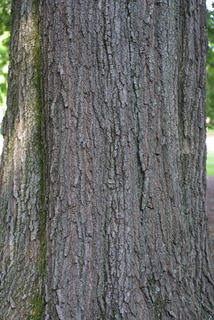
The bark is slightly furrowed and a medium-dark brown-grey sort of tone; I think I'd be careful not to mistake this with pine, myself, but I may be weird (no one opposes this).

http://www.discoverlife.org/IM/I_SB/0111/320/Quercus_phellos,_bark_-_of_a_large_tree,I_SB11159.jpg


Bald Cypress

http://en.wikipedia.org/wiki/Bald_cypress


I put this as the header photo for a particular reason. I think whenever I come up with bald cypress (otherwise known as Taxodium distichum), I think I'll likely think of bogs and marshes. A fan of wet places (or, at least, it seems perfectly fine being in those types of places; the ones on campus aren't exactly flooded, so it seems to be fine either way) it puts up little 'knees'. They were once thought to help the plant 'breath' - to collect or let off different gases depending on its needs - but that school of thought is out the window. Currently, it's thought that these growths are to keep the soil from washing away too far from the roots, like a truss.
http://en.wikipedia.org/wiki/Bald_cypress

Pyramidal in shape, the tree has needles year round but is not evergreen: they yellow and dry out, then fall off. They come back the next year, though; this process will scare some people, making them think they're little Christmas tree had died off. 
The tree is about a zone 6, and can reach up to around D.C. and Philadelphia before it just gets too cold - but it always keeps to the coast.

The tree is pretty great, though, and lends a nice, soft pine kind of feel to the landscape. It seems to grow more up than out (hence the pyramidal shape), so it isn't great for shade. I do like seeing them on campus: they seem to stick out from all the other trees. It's also the state tree of Louisiana as of 1963. I don't know about you, but when I think of Louisiana I think of swamps.


The needles give it a very soft appearance, and they feel similar to how they appear. 

http://en.wikipedia.org/wiki/Bald_cypress

http://en.wikipedia.org/wiki/Bald_cypress
The cones are little (not near the size you think of squirrels chewing on from those huge pines). 


http://en.wikipedia.org/wiki/Bald_cypress
The bark is shallow, though, and very easily damaged. It does appear very delicate, especially in comparison to things such as the maples I've posted about. It looks flaky. 

8.31.2012

Sugar Maple

http://www.quick-growing-trees.com/product_images/h/635/sn_maple_tree__56135_zoom.jpg


This is another tree from campus that I enjoyed over the fall. Between this and the red maple, I really felt like I wasn't down South anymore; the famed changing of the leaves up north (which is banked on pretty heavily, and people do plant just because of tourism) happens down here a little bit, as seen with trees like this one.

Quick fact: this is the Canadian flag tree leaf. Neat, huh?


http://en.wikipedia.org/wiki/Acer_saccharum
As one can see, it's a little more rounded and dense than the other maples I've put up so far. It's a pretty symmetrical type of tree, generally with five similarly-sized major lobes, and they're all palmate: each lobe and vein originate from a central point at the base of the leaf. 


http://en.wikipedia.org/wiki/Acer_saccharum
Again, remember how the leaves will alternate. 
I think these are a little pointier than the Silver Maple's leaves were. I think the tips of leaves help me out really well in remembering what they are. Everyone's going to have their own identification reason - be it the flag, or the color, or the thickness of the leaf, or the obvious palmation - but this one is pretty distinctive. 
If I remember correctly, the leaf is a bit bigger than the red maple (Acer rubrum) and a lot shallower with the lobe dissection than the Silver Maple (Acer saccharinum; oh yeah, I rock.)


I stuck in some color variation for fun. I thought it was pretty. I love leaves when they change. I must have played with them too much as a kid, or something.
http://en.wikipedia.org/wiki/Acer_saccharum
It's got great fall color and would definitely light up a landscape for the season. It's not exactly ugly with spring leaves, either. I rather like the shape, myself. 


http://en.wikipedia.org/wiki/Acer_saccharum

That's right! It's the syrup tree. However, they kind of need snowy-temperatures to really get the sap going.
How it works is the plant needs a cold season to do its thing. The heat really wears it out, meaning that it uses up more of its stored energy to deal with things than it would further up north. The tree's limit really is around South Carolina (and it doesn't exactly look thrilled to be here in the first place). 


http://en.wikipedia.org/wiki/Acer_saccharum
These are smaller winged samaras than some of the others, and less rounded in appearance than the silver maple (Acer saccharinum). There also doesn't seem to be as much call for coloration in the seed, although I could be wrong about that. The red maple (Acer rubrum) seemed to have quite a lot more than this picture here has, but, as I've said before, maples seem to like to do whatever they want.


http://en.wikipedia.org/wiki/Acer_saccharum
Again, I've pulled up a bark photo. It's a little darker than some of the others, and also grooved. It generally has smooth, gray bark which has giant pieces peel off - but that's more common further north than it is down here.
The tree is pretty gorgeous, and useful in colder states, but doesn't like it down south or in the heat very much. It also isn't great in parking lots - doesn't like road salt or compaction at all. Generally speaking, it's what I'd call a farm-tree: keep it somewhere where people and cars won't really be interfering with it and it should be fine. I always picture goats walking around it, using it for cover in the rain, or something. 

Silver Maple

http://en.wikipedia.org/wiki/Silver_maple
 Acer saccharinum, not to be confused with A. saccharum, which is a sugar maple (syrup, anyone?), I think this tree's most notable characteristic is it's silver-underside leaf.
http://en.wikipedia.org/wiki/Silver_maple
The lobes are a little more defined, I think, than the generally-three lobed, balanced shape of the red maple (Acer rubrum; I'm trying to memorize this sort of thing.)

http://en.wikipedia.org/wiki/Silver_maple


The angles in the leaf are more defined, but not necessarily pointy (I've seen pointier leaves in other maples so far).
The sinus (veins) are deep, easily noticeable.


http://en.wikipedia.org/wiki/Silver_maple

It's a little hard to tell, but if you really look at it you can see the alternation of the leaves. They don't bunch up, but hang out in pairs.


The tree grows quickly, and generally has brittle wood. That means it tends to lose limbs. People like the way it looks - and appreciates the speed of its growth - which is why it's used often enough. The roots like to seek out water sources, though, making it similar to the willow with how it wants to get into water lines and such. 
The limbs 'split' early in growth, meaning that there's a little base at the bottom where a couple-few large limbs will branch out at an angle. This puts stress on the tree. Strong angles and weak wood generally mean that when the tree's limbs get heavy, or if a storm comes by and stresses it enough, it'll drop those limbs - and the ones I've seen weren't small. Pruning early can theoretically prevent this, but most people wouldn't do that. 

*Note: I'm not exactly adept in this yet, so this MIGHT not be a silver maple. The internet says it is. I'd like to say I'm using the trunk as an example of what I'm about to talk about, not necessarily to prove what the bark looks like.
http://cdn.c.photoshelter.com/img-get/I0000K9jr167PcHQ/s/750/750/tree-trunk-826.jpg
This trunk has some obvious splitting points. It's not quite as much of an extreme angle as it could be, so it may live longer before dropping a limb, but it's bound to happen.

The one I saw on campus had a split of three trunks from the base, and there's almost a line in the bark where one can tell where the stress will split the wood. It's still a nice tree, and provides good shade, so I personally think it was a nice choice. I just hope people understood that the tree won't look exactly like that for hundreds of years.


The samaras are a little more squat and bolder in color, from the looks of things, than reds - but, so far I've learned to be careful with trying to depend on consistencies so desperately. They do seem more rounded, though, and in general it appears to be pretty easy to tell the samaras apart from the red maple's.


http://en.wikipedia.org/wiki/Silver_maple
 The bark is grooved but not as extremely much as I saw with the red. It seems to be a little more delicate, and it is, in a sense. The wood grows pretty quickly. The tree loves water, and I can understand why: it grows well in the midwest (one of few, it seems, that doesn't mind growing there) and I'm sure water is a different matter altogether than it is here, as far as acquisition is concerned.


http://www.dcnr.state.pa.us/forestry/commontr/images/SilverMaple.gif 

I actually rather liked this diagram for the general perspective of trying to understand how this one differs from the others. People can tell trees apart by just the growth of a stem, and that fascinates me. Looks like a stick to me, at the moment, with some little buds and such.