Showing posts with label fast growth. Show all posts

9.19.2012

Freeman's Maple - Acer X freemanii


The tree in it's attempt to take over that poor little old lady. RUN LITTLE OLD LADY!
This is a natural hybrid of A. rubrum and A. saccharum -> red maple and silver maple.
It has the best traits of both species: it grows faster than red maple; it has stronger wood and better fall color (remember, red maples have GREAT fall color, but silvers suck).


I like this bark better than some
It's not so.. boring.
Look, texture! Brown tones! Highlights!


There is a long petiole (quite long; and the petiole is the connector between the base of the leaf and the stem) and it's red. Red maples aren't consistently much of anything - they can be red, or not, or striped; they can have open canopies, or not; you get the idea. Remember? Well, Freeman's Maple tends to be a bit more consistent.


 It also doesn't have the silver under the leaf  and has deeply dissected lobes (think fingers as opposed to paws: paws tend to be rounded with very little in-between-the-toes space, while fingers have a ton of space between the toes). There are 3 lobes. This sets it way apart from the two species it was born from.


These are the samaras - seeds. They're very distinctive. If you remember the norway, they were glossy and a fresh froggy-green color. These are, well, red. Look how pretty they actually are!

8.31.2012

Silver Maple

http://en.wikipedia.org/wiki/Silver_maple
 Acer saccharinum, not to be confused with A. saccharum, which is a sugar maple (syrup, anyone?), I think this tree's most notable characteristic is it's silver-underside leaf.
http://en.wikipedia.org/wiki/Silver_maple
The lobes are a little more defined, I think, than the generally-three lobed, balanced shape of the red maple (Acer rubrum; I'm trying to memorize this sort of thing.)

http://en.wikipedia.org/wiki/Silver_maple


The angles in the leaf are more defined, but not necessarily pointy (I've seen pointier leaves in other maples so far).
The sinus (veins) are deep, easily noticeable.


http://en.wikipedia.org/wiki/Silver_maple

It's a little hard to tell, but if you really look at it you can see the alternation of the leaves. They don't bunch up, but hang out in pairs.


The tree grows quickly, and generally has brittle wood. That means it tends to lose limbs. People like the way it looks - and appreciates the speed of its growth - which is why it's used often enough. The roots like to seek out water sources, though, making it similar to the willow with how it wants to get into water lines and such. 
The limbs 'split' early in growth, meaning that there's a little base at the bottom where a couple-few large limbs will branch out at an angle. This puts stress on the tree. Strong angles and weak wood generally mean that when the tree's limbs get heavy, or if a storm comes by and stresses it enough, it'll drop those limbs - and the ones I've seen weren't small. Pruning early can theoretically prevent this, but most people wouldn't do that. 

*Note: I'm not exactly adept in this yet, so this MIGHT not be a silver maple. The internet says it is. I'd like to say I'm using the trunk as an example of what I'm about to talk about, not necessarily to prove what the bark looks like.
http://cdn.c.photoshelter.com/img-get/I0000K9jr167PcHQ/s/750/750/tree-trunk-826.jpg
This trunk has some obvious splitting points. It's not quite as much of an extreme angle as it could be, so it may live longer before dropping a limb, but it's bound to happen.

The one I saw on campus had a split of three trunks from the base, and there's almost a line in the bark where one can tell where the stress will split the wood. It's still a nice tree, and provides good shade, so I personally think it was a nice choice. I just hope people understood that the tree won't look exactly like that for hundreds of years.


The samaras are a little more squat and bolder in color, from the looks of things, than reds - but, so far I've learned to be careful with trying to depend on consistencies so desperately. They do seem more rounded, though, and in general it appears to be pretty easy to tell the samaras apart from the red maple's.


http://en.wikipedia.org/wiki/Silver_maple
 The bark is grooved but not as extremely much as I saw with the red. It seems to be a little more delicate, and it is, in a sense. The wood grows pretty quickly. The tree loves water, and I can understand why: it grows well in the midwest (one of few, it seems, that doesn't mind growing there) and I'm sure water is a different matter altogether than it is here, as far as acquisition is concerned.


http://www.dcnr.state.pa.us/forestry/commontr/images/SilverMaple.gif 

I actually rather liked this diagram for the general perspective of trying to understand how this one differs from the others. People can tell trees apart by just the growth of a stem, and that fascinates me. Looks like a stick to me, at the moment, with some little buds and such. 

Babylon Weeping Willow

Otherwise known as the Peking Willow (Salix babylonica), this is the tree that a lot of people think of appearing near lakes or at graveyards.


http://en.wikipedia.org/wiki/Salix_babylonica
 Obviously, in the correct landscape (which is the point of the class I'm doing this blog for, at the moment) this tree is actually really gorgeous. Weeping branches are very easily identifiable: 5th graders know what this tree is and I remember thinking they were the coolest looking things ever. I grew up around a lot of pine, and these soft, flowy trees were a very light, gentle contrast to such a hard, enduring type of plant.
These are pretty good at softening hard corners, or otherwise adding some grace or a feeling of gentleness to the landscape. It's good for shade, and I remember being a kid and watching a friend's parents make out underneath one - so there is some romantic appeal to it, I suppose. People seem to feel comfortable around these trees.
http://en.wikipedia.org/wiki/Salix_babylonica
 I've never really studied the flowers, and my initial thought is that they look like the best reason to sneeze ever. We won't be dealing with the flowers much this semester, I expect: I don't remember seeing willows flower in the fall, but I could be wrong. That's happened before (rarely. Ha.)
http://en.wikipedia.org/wiki/Salix_babylonica

 This flowy plant likes water. From how things sound, I wouldn't end up making this an urbanite type of tree. It needs space for multiple reasons. For one, it likes to seek out water. Remember how I said people tend to remember seeing it near ponds? It prefers seeking out water with its roots with some efficiency. This tree shouldn't be put near gutters or other water-collection (pipes, sewer, wells, septic tanks and lines) that you'd like to keep intact. If you have a big old lake, then obviously this tree will be perfectly happy - given it has enough space to grow. This pond idea has a perk, which I'll get into next.


This is a close-up of some bark! Look at it! Bark!
The native Americans chewed on the bark for a numbing effect. Salicaeae - the unsynthesized source of Aspirin - is a natural wildlife repellent. To humans it's not so bad (convenient sometimes), but I'm sure it's a deterrent to small woodland bugs.
http://en.wikipedia.org/wiki/Salix_babylonica


The bark is a bit messy looking, in my opinion. The coloration is notable, and as I write this I noticed something: with the green growth cut out of the equation, this reminds me of how I'd picture a more arid-landscape tree's bark looking like. It looks extra dry and unhappy. There's no real uniform pattern or design going on (unlike the pines I've seen, for instance; I'm not saying I'd mistake this tree for a pine initially, but what if I had to identify this without green growth or flowers? I'd hope it wouldn't just be from bark, but who knows what people will come up with?) It's pretty rough and otherwise grooved.

The wood itself is weak; the tree grows quickly, and there seems to be a decent correlation between growth rate and wood hardness. The tree likes to grow with some room, and if in compacted corners it likes to drop limbs. In general, from how things sounded, this is pretty inevitable.

en.wikipedia.org/wiki/Salix_babylonica 

The leaves are long and serrated on the edges, with a rough underside. They're also similar to Willow Oak (which I'll get into later) but oaks are a completely different matter and one should be able to tell these trees apart.

The tree looks similar to a Black Willow, but the BW isn't as pretty and flowy as this. If one has the space (and water source) willing to dedicate to a willow, then I would grab the Babylon.


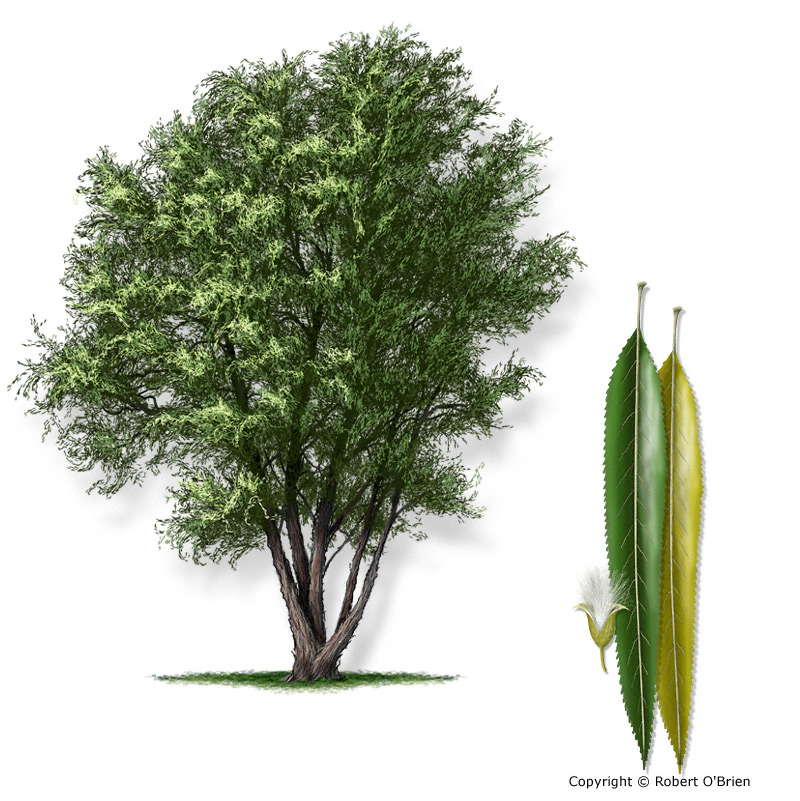
Black Willow (Salix Nigra)
http://texastreeid.tamu.edu/images/TreeImages/willow_black150.jpg


This is a Black Willow. To me it's just a tree. I think I'd grab a maple over this (especially a Japanese Red)