Showing posts with label grooved bark. Show all posts

8.31.2012

Sugar Maple

http://www.quick-growing-trees.com/product_images/h/635/sn_maple_tree__56135_zoom.jpg


This is another tree from campus that I enjoyed over the fall. Between this and the red maple, I really felt like I wasn't down South anymore; the famed changing of the leaves up north (which is banked on pretty heavily, and people do plant just because of tourism) happens down here a little bit, as seen with trees like this one.

Quick fact: this is the Canadian flag tree leaf. Neat, huh?


http://en.wikipedia.org/wiki/Acer_saccharum
As one can see, it's a little more rounded and dense than the other maples I've put up so far. It's a pretty symmetrical type of tree, generally with five similarly-sized major lobes, and they're all palmate: each lobe and vein originate from a central point at the base of the leaf. 


http://en.wikipedia.org/wiki/Acer_saccharum
Again, remember how the leaves will alternate. 
I think these are a little pointier than the Silver Maple's leaves were. I think the tips of leaves help me out really well in remembering what they are. Everyone's going to have their own identification reason - be it the flag, or the color, or the thickness of the leaf, or the obvious palmation - but this one is pretty distinctive. 
If I remember correctly, the leaf is a bit bigger than the red maple (Acer rubrum) and a lot shallower with the lobe dissection than the Silver Maple (Acer saccharinum; oh yeah, I rock.)


I stuck in some color variation for fun. I thought it was pretty. I love leaves when they change. I must have played with them too much as a kid, or something.
http://en.wikipedia.org/wiki/Acer_saccharum
It's got great fall color and would definitely light up a landscape for the season. It's not exactly ugly with spring leaves, either. I rather like the shape, myself. 


http://en.wikipedia.org/wiki/Acer_saccharum

That's right! It's the syrup tree. However, they kind of need snowy-temperatures to really get the sap going.
How it works is the plant needs a cold season to do its thing. The heat really wears it out, meaning that it uses up more of its stored energy to deal with things than it would further up north. The tree's limit really is around South Carolina (and it doesn't exactly look thrilled to be here in the first place). 


http://en.wikipedia.org/wiki/Acer_saccharum
These are smaller winged samaras than some of the others, and less rounded in appearance than the silver maple (Acer saccharinum). There also doesn't seem to be as much call for coloration in the seed, although I could be wrong about that. The red maple (Acer rubrum) seemed to have quite a lot more than this picture here has, but, as I've said before, maples seem to like to do whatever they want.


http://en.wikipedia.org/wiki/Acer_saccharum
Again, I've pulled up a bark photo. It's a little darker than some of the others, and also grooved. It generally has smooth, gray bark which has giant pieces peel off - but that's more common further north than it is down here.
The tree is pretty gorgeous, and useful in colder states, but doesn't like it down south or in the heat very much. It also isn't great in parking lots - doesn't like road salt or compaction at all. Generally speaking, it's what I'd call a farm-tree: keep it somewhere where people and cars won't really be interfering with it and it should be fine. I always picture goats walking around it, using it for cover in the rain, or something. 

Red Maple

http://en.wikipedia.org/wiki/Acer_rubrum
Red maples aren't usually red. Go figure. So, get that out of your head now while you can. I know, I was annoyed, too. What gives? Is it the petiole (the little stem coming straight from the leaf onto the branch)? Not really. Underside of the leaf? Not really. Bark? Nope. Running out of options, right?

Acer rubrum is actually really pretty. We have one on campus in a little courtyard type of spot right beside the parking lot to the library, and I remember being on campus last year and yoinking a shot of it from my camera.


This is what the tree looks like in the fall, if it's doing what it's supposed to and losing it's pigment.
http://en.wikipedia.org/wiki/Acer_rubrum
 I like to think of it as having nice, delicate branches from a good trunk; the canopy seems pretty rounded and overall it has a good, shading shape. The shape does vary, though, and it can be taller or less dense depending on the type (and maples like to hybridize like naughty little buggers, so it's possible to see something like this and it isn't exactly a rubrum.)

The roots are shallow, though, meaning it'll be hard to plant much of anything underneath it. Considering it also tends to be pretty shady, in a manner of speaking, not much will like being there anyway. I'd justify adding some birdhouses or feeders to hang from it, myself. So, it needs a little space, but it does lighten up the scenery very well in the fall. I remember it turning at around October last year, which really gave everything a nice autumn/Halloween type of feel. It is definitely a better choice than 'paper-bag brown' as Dr. Adelberg likes to put it.
http://en.wikipedia.org/wiki/Acer_rubrum
 The bark is furrowed and a nice uniform brown. Although it doesn't really have much of a pattern, like that pine I never remembered the name of, it is definitely different than the willow I posted about earlier.
http://en.wikipedia.org/wiki/Acer_rubrum
Also, the flowers on the tree are red and like to bloom around February, giving things a little bit of color before spring life floats up too much.
http://en.wikipedia.org/wiki/Acer_rubrum

 The seeds, Samaras, come in clusters like this.  They generally seem to come paired and will helicopter down (we've all chased them as kids, don't lie about it). The tinges, I'm sure, can be different depending on the tree, but what I can observe is that they're pretty uniform in shape, size and color.


The leaves themselves are pretty evenly shaped, generally with three lobes. 
If one knows anything about trees, telling maples apart from everything else is pretty simple: the leaves are always opposite in maples. Willows, and so forth, tend to alternate. If you look at a cluster, one can see the leaves of maples grow across from each other, rather than taking turns down the stem. 

http://en.wikipedia.org/wiki/Acer_rubrum


The deepness of the veins can vary, and the deepness of the dissection between lobes can vary. Generally, though, it seems to sport squat, even lobes, making it appear pretty uniform (not really any more squat than wide, etc). 

As far as soils and temperature, it can vary. It seems to tolerate different soils, and definitely different temperatures, to a point. It'll grow along roads, and probably takes salt relatively well - it does grow up north as well as here in SC.

I like them better by themselves. As far as design, I found I really like the one at the library. Why? It's one of two, that I really remember, that lit everything else up with a fiery red color. The other trees were still thinking about changing color, or had lost their leaves completely, meaning this one took center stage. Being around some deep evergreens would also be nice: I love strong contrasts like that, and so keeping this around some firs or deep pines would be picturesque in my opinion. Putting a lot of things around it, though, I believe would detract from the overall beauty: it's pretty on its own and seems to want its own space.

http://img.ehowcdn.com/article-new/ehow/images/a06/3a/7c/prune-red-maple-tree-800x800.jpg


Considering that, I do have to say that these trees wouldn't be good as roadside growth: they aren't uniform enough in shape from plant-to-plant to make it look presentable in a row. I can understand having a road full of fiery reds (mix in some gold-fall color and it would be fantastic) would be nice, but as far as year-round uniformity, it's missing an element physically. Personally, if that were an interest, I'd make it one of few and put other, more uniform plants near it.

Babylon Weeping Willow

Otherwise known as the Peking Willow (Salix babylonica), this is the tree that a lot of people think of appearing near lakes or at graveyards.


http://en.wikipedia.org/wiki/Salix_babylonica
 Obviously, in the correct landscape (which is the point of the class I'm doing this blog for, at the moment) this tree is actually really gorgeous. Weeping branches are very easily identifiable: 5th graders know what this tree is and I remember thinking they were the coolest looking things ever. I grew up around a lot of pine, and these soft, flowy trees were a very light, gentle contrast to such a hard, enduring type of plant.
These are pretty good at softening hard corners, or otherwise adding some grace or a feeling of gentleness to the landscape. It's good for shade, and I remember being a kid and watching a friend's parents make out underneath one - so there is some romantic appeal to it, I suppose. People seem to feel comfortable around these trees.
http://en.wikipedia.org/wiki/Salix_babylonica
 I've never really studied the flowers, and my initial thought is that they look like the best reason to sneeze ever. We won't be dealing with the flowers much this semester, I expect: I don't remember seeing willows flower in the fall, but I could be wrong. That's happened before (rarely. Ha.)
http://en.wikipedia.org/wiki/Salix_babylonica

 This flowy plant likes water. From how things sound, I wouldn't end up making this an urbanite type of tree. It needs space for multiple reasons. For one, it likes to seek out water. Remember how I said people tend to remember seeing it near ponds? It prefers seeking out water with its roots with some efficiency. This tree shouldn't be put near gutters or other water-collection (pipes, sewer, wells, septic tanks and lines) that you'd like to keep intact. If you have a big old lake, then obviously this tree will be perfectly happy - given it has enough space to grow. This pond idea has a perk, which I'll get into next.


This is a close-up of some bark! Look at it! Bark!
The native Americans chewed on the bark for a numbing effect. Salicaeae - the unsynthesized source of Aspirin - is a natural wildlife repellent. To humans it's not so bad (convenient sometimes), but I'm sure it's a deterrent to small woodland bugs.
http://en.wikipedia.org/wiki/Salix_babylonica


The bark is a bit messy looking, in my opinion. The coloration is notable, and as I write this I noticed something: with the green growth cut out of the equation, this reminds me of how I'd picture a more arid-landscape tree's bark looking like. It looks extra dry and unhappy. There's no real uniform pattern or design going on (unlike the pines I've seen, for instance; I'm not saying I'd mistake this tree for a pine initially, but what if I had to identify this without green growth or flowers? I'd hope it wouldn't just be from bark, but who knows what people will come up with?) It's pretty rough and otherwise grooved.

The wood itself is weak; the tree grows quickly, and there seems to be a decent correlation between growth rate and wood hardness. The tree likes to grow with some room, and if in compacted corners it likes to drop limbs. In general, from how things sounded, this is pretty inevitable.

en.wikipedia.org/wiki/Salix_babylonica 

The leaves are long and serrated on the edges, with a rough underside. They're also similar to Willow Oak (which I'll get into later) but oaks are a completely different matter and one should be able to tell these trees apart.

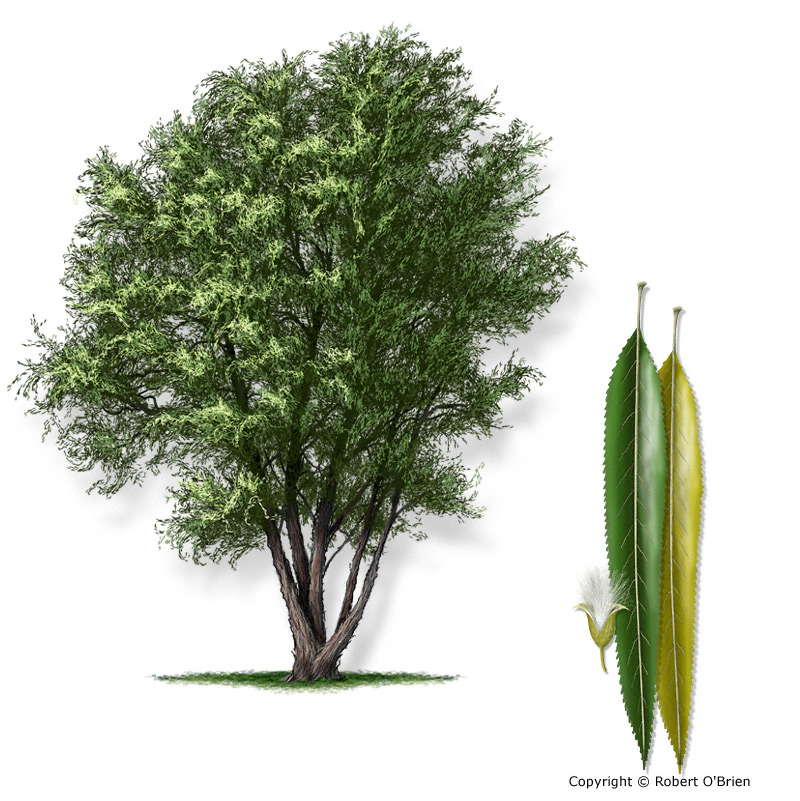
The tree looks similar to a Black Willow, but the BW isn't as pretty and flowy as this. If one has the space (and water source) willing to dedicate to a willow, then I would grab the Babylon.


Black Willow (Salix Nigra)
http://texastreeid.tamu.edu/images/TreeImages/willow_black150.jpg


This is a Black Willow. To me it's just a tree. I think I'd grab a maple over this (especially a Japanese Red)