Showing posts with label oak. Show all posts

9.19.2012

White Oak - Q. alba


This is in Baltimore at the UMD Botanical Gardens, or some such.

The spread on this tree can be extremely wide. This is why it is recommended to give it a LOT of reach-room!
White oaks set the standard for a lot of other oaks. A very large tree when fully grown, it grows into an awe-inspiring oval or rounded outline. The leaves are dark green or blue-green and have rounded lobes that turn to brown, red or burgundy in the fall. This is a tree best transplanted only when young, and lives for quite some time. Considering it's grandeur (and the fact that it doesn't branch like a Bur Oak), this is a tree that's fairly simple to identify.
This can easily be found here: University of Connecticut

The tree enjoys full sun and demands it: it'll grow over just about anything else, becoming a fantastic shade tree. It takes up a pretty large area, but is one of the most desirable, attractive oaks available.


It does enjoy more acidic soil and dislikes being disturbed (not a fan of compaction, construction). It is a slow growing tree, which isn't a surprise due to its size and wood strength. One must be cautious of gypsy moths (kill on sight!) Generally, though, damage is rarely significant.


These are young spring-growth leaves

White, chunky bark is attractive year round - if you're into white, chunky bark.

 This is a GREAT tree to preserve if it is located on a property that may have some contruction done. But, this is also one of those trees that can take a beating from construction. Be extra careful when it comes to protecting large trees such as this, because it can take years before it actually shows wear and tear - and by then, we generally have moved on and quit worrying, right?
 

http://upload.wikimedia.org/wikipedia/commons/9/9c/White_oak_Quercus_alba_prolific_acorns.jpg
Acorns are fairly large and the caps appear to cover perhaps a half of the nut.


9.01.2012

Willow Oak

http://en.wikipedia.org/wiki/Willow_oak
Otherwise known as Quercus phellos, is a big tree that transplants easily, grows easily and takes 'bad' soils. If one remembers about trees from my earlier posts, I seemed to lean toward the idea that fast-growing large trees like to toss limbs after a while. This one will toss a few, but not as badly as some similarly-growing trees. 

They have a full crown and generally grow to be pretty symmetrical. They grow down south pretty readily; up north, the similar option to cultivate is the pin oak. I've heard good things about both; people seem pretty bias toward one or the other for various reasons, but it's too hot down here for a pin oak.

The willow oak is pretty common here on Clemson campus, and have a nice fall color - usually. From what I've seen, the tree can be green, red or yellowy, which isn't half bad. It's commonly planted because of the good qualities I've mentioned, but it also gets bigger than some planners expect. It ends up putting roots through sidewalks and things because of that.


http://www.duke.edu/~cwcook/trees/quph50728.jpg
See the leaves? They cluster at the end (terminal bud). That's an oak trait. Maples, if you remember, like to go in pairs and don't really cluster like this at the end of the limb. Oaks tend to alternate and have two general differences: red oaks tend to have pointy little leaves like this picture up here. White oaks have rounded-tipped leaves. The two cannot interbreed, and so knowing how their leaves are (pointed or dull and rounded) is really helpful in identifying it.

forestfarm.com/images/products/3833/quph100v3.jpg


Notably, it's called a willow oak for a reason: it has leaves that are similar to a weeping willow (such as the Babylon Weeping Willow, Salix babylonica) but, apart from that, they aren't incredibly similar. Weeping willow, well, weeps, for one. If that doesn't tip you off, then I've got bad news for you.


gardens.missouri.edu/about/descriptions/treetrails/TTmaps/LowryMallPhotos/lowryweb/Quercus-phellos-fall-lg.jpg


forestry.sfasu.edu/faculty/jstovall/dendro//
images/tree_photos/querphel/querphel_fruit1.jpg

cas.vanderbilt.edu/
bioimages/biohires/q/hquph--fr15633.jpg

 This is a large tree.
 It has tiny acorns.
 Tiny, cute little acorns.


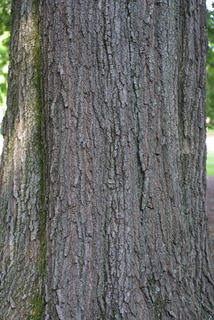
The bark is slightly furrowed and a medium-dark brown-grey sort of tone; I think I'd be careful not to mistake this with pine, myself, but I may be weird (no one opposes this).

http://www.discoverlife.org/IM/I_SB/0111/320/Quercus_phellos,_bark_-_of_a_large_tree,I_SB11159.jpg