Showing posts with label good fall color. Show all posts

9.19.2012

Freeman's Maple - Acer X freemanii


The tree in it's attempt to take over that poor little old lady. RUN LITTLE OLD LADY!
This is a natural hybrid of A. rubrum and A. saccharum -> red maple and silver maple.
It has the best traits of both species: it grows faster than red maple; it has stronger wood and better fall color (remember, red maples have GREAT fall color, but silvers suck).


I like this bark better than some
It's not so.. boring.
Look, texture! Brown tones! Highlights!


There is a long petiole (quite long; and the petiole is the connector between the base of the leaf and the stem) and it's red. Red maples aren't consistently much of anything - they can be red, or not, or striped; they can have open canopies, or not; you get the idea. Remember? Well, Freeman's Maple tends to be a bit more consistent.


 It also doesn't have the silver under the leaf  and has deeply dissected lobes (think fingers as opposed to paws: paws tend to be rounded with very little in-between-the-toes space, while fingers have a ton of space between the toes). There are 3 lobes. This sets it way apart from the two species it was born from.


These are the samaras - seeds. They're very distinctive. If you remember the norway, they were glossy and a fresh froggy-green color. These are, well, red. Look how pretty they actually are!

8.31.2012

Ginkgo!

Ginkgo biloba is a neat tree.

http://en.wikipedia.org/wiki/Ginko_biloba

Ginkgo is a large tree that will grow to nicely avoid buildings. A lot of trees (like the ash outside my window that I need to remove) love to just grow into whatever. So, from a landscaping standpoint, this unique tree is a good choice to place in a busier location. We have a few on campus, which are well looked after and most people don't pay them much mind. There's also another, though, in a parking lot in downtown Clemson that I didn't know was there until this afternoon.


This tree is essentially bullet proof. It's okay with rain, heat, bugs, you name it. Not much really happens to it, but it doesn't really like road salt  or compaction very much. Who does, though? Walk all over your buddies and see how they like it. Same general idea with the root systems of a lot of plants. They need space in that soil to breathe. Generally, though, considering this tree should be extinct, I think it's faring pretty well.

http://en.wikipedia.org/wiki/Ginko_biloba


http://en.wikipedia.org/wiki/Ginko_biloba

The yellow leaves are how they look in the fall, which I think is really pretty. Reminds me of bananas as fans. 
The veination is neat: it's fanned out as an oddly-palmate type of thing. Each vein is the same width. It's an extremely primitive way of doing things - like liverwort or seaweed. In the scheme of plant development, these came before other, more popular plants, such as angiosperms (flowering ones) and conifers. 
Essentially, the plant is outdated, but seems to be doing just fine on campus.

The plant was going to go extinct, but some monks saved it. Asian cuisine loves the nuts, and the leaves are good for helping memory retention - from what I understand. I've also watched a guy eat one, and it didn't seem to be all that tasty, so I think I'll stick with an extract if I feel forgetful.


http://en.wikipedia.org/wiki/Ginko_biloba


en.wikipedia.org/wiki/Ginko_biloba


en.wikipedia.org/wiki/Ginko_biloba
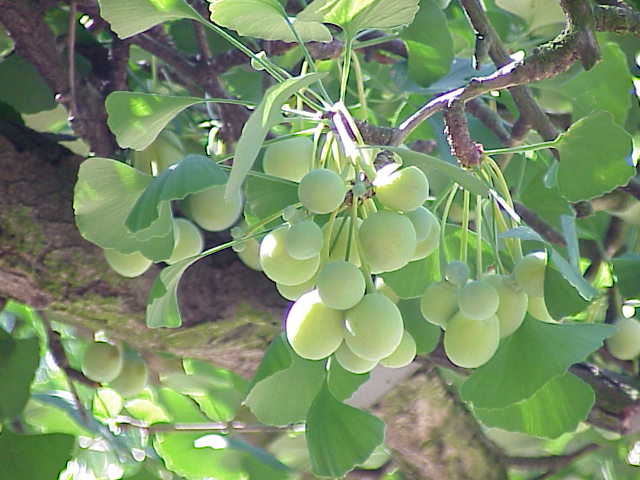
There are male and female trees, strictly speaking. A lot of plants will have parts from both sexes, but not these guys. The guys (on the left) have the flowers. The females receive pollen much - at least, how I see it - like pine trees. The 'fruits' are technically cones, considering the seed doesn't form in an ovary. Picky picky little details like that mean that the stinky, fleshy pulp around the seed isn't really fruit.
Call it what you will, there's no way I want to open one. It apparently smells like rancid butter. Ew.


Nerd-fact: This is the only land-plant that has sperm that swim with a flagellum. The female has her ovary on the surface, and in wet climates (think ferns) this was an especially convenient way to propagate seed. Generally, though, angiosperms took over (conifers like to just puff out as much of their mess as possible and hope it lands on a girl part somewhere else, which is why I hate them) because, partially, of their great reproductive method. Again, this plant is pretty well out-dated.


http://en.wikipedia.org/wiki/Ginko_biloba
There's the fruit! People love that stuff (the seed, not the..'fruit'.)


http://en.wikipedia.org/wiki/Ginko_biloba


I think this photo is GORGEOUS. Look at that fall color! It is a big tree, so I wouldn't put it on a 1/4 acre lot (I'm still unsure why it's in a parking lot downtown; who decided on that? Really?) but if there IS one around it looks brilliant! The course I'm taking is 'Growing Fall Plants', hence the fall-color emphasis I've been using lately.


The plant has good, strong wood, and a decent - not fast - growth rate. It takes horrible soils (just doesn't like a lot of road-salt and people walking on it). It's pretty easy to get along with. It would be hard to say if it's native, considering it's.. well, it's an oddity as far as survival goes. It lives because people wanted it to, pretty much; I doubt it'd be around if the Chinese weren't so appreciative of ginkgo seeds.

http://en.wikipedia.org/wiki/Ginko_biloba


This is the bark. I think it's much prettier than the Acer saccharum was (it was gray-brown and whatnot). The plant, generally, just looks happier and less gloomy than some of the others we've looked at.
http://en.wikipedia.org/wiki/Ginko_biloba

Sugar Maple

http://www.quick-growing-trees.com/product_images/h/635/sn_maple_tree__56135_zoom.jpg


This is another tree from campus that I enjoyed over the fall. Between this and the red maple, I really felt like I wasn't down South anymore; the famed changing of the leaves up north (which is banked on pretty heavily, and people do plant just because of tourism) happens down here a little bit, as seen with trees like this one.

Quick fact: this is the Canadian flag tree leaf. Neat, huh?


http://en.wikipedia.org/wiki/Acer_saccharum
As one can see, it's a little more rounded and dense than the other maples I've put up so far. It's a pretty symmetrical type of tree, generally with five similarly-sized major lobes, and they're all palmate: each lobe and vein originate from a central point at the base of the leaf. 


http://en.wikipedia.org/wiki/Acer_saccharum
Again, remember how the leaves will alternate. 
I think these are a little pointier than the Silver Maple's leaves were. I think the tips of leaves help me out really well in remembering what they are. Everyone's going to have their own identification reason - be it the flag, or the color, or the thickness of the leaf, or the obvious palmation - but this one is pretty distinctive. 
If I remember correctly, the leaf is a bit bigger than the red maple (Acer rubrum) and a lot shallower with the lobe dissection than the Silver Maple (Acer saccharinum; oh yeah, I rock.)


I stuck in some color variation for fun. I thought it was pretty. I love leaves when they change. I must have played with them too much as a kid, or something.
http://en.wikipedia.org/wiki/Acer_saccharum
It's got great fall color and would definitely light up a landscape for the season. It's not exactly ugly with spring leaves, either. I rather like the shape, myself. 


http://en.wikipedia.org/wiki/Acer_saccharum

That's right! It's the syrup tree. However, they kind of need snowy-temperatures to really get the sap going.
How it works is the plant needs a cold season to do its thing. The heat really wears it out, meaning that it uses up more of its stored energy to deal with things than it would further up north. The tree's limit really is around South Carolina (and it doesn't exactly look thrilled to be here in the first place). 


http://en.wikipedia.org/wiki/Acer_saccharum
These are smaller winged samaras than some of the others, and less rounded in appearance than the silver maple (Acer saccharinum). There also doesn't seem to be as much call for coloration in the seed, although I could be wrong about that. The red maple (Acer rubrum) seemed to have quite a lot more than this picture here has, but, as I've said before, maples seem to like to do whatever they want.


http://en.wikipedia.org/wiki/Acer_saccharum
Again, I've pulled up a bark photo. It's a little darker than some of the others, and also grooved. It generally has smooth, gray bark which has giant pieces peel off - but that's more common further north than it is down here.
The tree is pretty gorgeous, and useful in colder states, but doesn't like it down south or in the heat very much. It also isn't great in parking lots - doesn't like road salt or compaction at all. Generally speaking, it's what I'd call a farm-tree: keep it somewhere where people and cars won't really be interfering with it and it should be fine. I always picture goats walking around it, using it for cover in the rain, or something. 

Red Maple

http://en.wikipedia.org/wiki/Acer_rubrum
Red maples aren't usually red. Go figure. So, get that out of your head now while you can. I know, I was annoyed, too. What gives? Is it the petiole (the little stem coming straight from the leaf onto the branch)? Not really. Underside of the leaf? Not really. Bark? Nope. Running out of options, right?

Acer rubrum is actually really pretty. We have one on campus in a little courtyard type of spot right beside the parking lot to the library, and I remember being on campus last year and yoinking a shot of it from my camera.


This is what the tree looks like in the fall, if it's doing what it's supposed to and losing it's pigment.
http://en.wikipedia.org/wiki/Acer_rubrum
 I like to think of it as having nice, delicate branches from a good trunk; the canopy seems pretty rounded and overall it has a good, shading shape. The shape does vary, though, and it can be taller or less dense depending on the type (and maples like to hybridize like naughty little buggers, so it's possible to see something like this and it isn't exactly a rubrum.)

The roots are shallow, though, meaning it'll be hard to plant much of anything underneath it. Considering it also tends to be pretty shady, in a manner of speaking, not much will like being there anyway. I'd justify adding some birdhouses or feeders to hang from it, myself. So, it needs a little space, but it does lighten up the scenery very well in the fall. I remember it turning at around October last year, which really gave everything a nice autumn/Halloween type of feel. It is definitely a better choice than 'paper-bag brown' as Dr. Adelberg likes to put it.
http://en.wikipedia.org/wiki/Acer_rubrum
 The bark is furrowed and a nice uniform brown. Although it doesn't really have much of a pattern, like that pine I never remembered the name of, it is definitely different than the willow I posted about earlier.
http://en.wikipedia.org/wiki/Acer_rubrum
Also, the flowers on the tree are red and like to bloom around February, giving things a little bit of color before spring life floats up too much.
http://en.wikipedia.org/wiki/Acer_rubrum

 The seeds, Samaras, come in clusters like this.  They generally seem to come paired and will helicopter down (we've all chased them as kids, don't lie about it). The tinges, I'm sure, can be different depending on the tree, but what I can observe is that they're pretty uniform in shape, size and color.


The leaves themselves are pretty evenly shaped, generally with three lobes. 
If one knows anything about trees, telling maples apart from everything else is pretty simple: the leaves are always opposite in maples. Willows, and so forth, tend to alternate. If you look at a cluster, one can see the leaves of maples grow across from each other, rather than taking turns down the stem. 

http://en.wikipedia.org/wiki/Acer_rubrum


The deepness of the veins can vary, and the deepness of the dissection between lobes can vary. Generally, though, it seems to sport squat, even lobes, making it appear pretty uniform (not really any more squat than wide, etc). 

As far as soils and temperature, it can vary. It seems to tolerate different soils, and definitely different temperatures, to a point. It'll grow along roads, and probably takes salt relatively well - it does grow up north as well as here in SC.

I like them better by themselves. As far as design, I found I really like the one at the library. Why? It's one of two, that I really remember, that lit everything else up with a fiery red color. The other trees were still thinking about changing color, or had lost their leaves completely, meaning this one took center stage. Being around some deep evergreens would also be nice: I love strong contrasts like that, and so keeping this around some firs or deep pines would be picturesque in my opinion. Putting a lot of things around it, though, I believe would detract from the overall beauty: it's pretty on its own and seems to want its own space.

http://img.ehowcdn.com/article-new/ehow/images/a06/3a/7c/prune-red-maple-tree-800x800.jpg


Considering that, I do have to say that these trees wouldn't be good as roadside growth: they aren't uniform enough in shape from plant-to-plant to make it look presentable in a row. I can understand having a road full of fiery reds (mix in some gold-fall color and it would be fantastic) would be nice, but as far as year-round uniformity, it's missing an element physically. Personally, if that were an interest, I'd make it one of few and put other, more uniform plants near it.