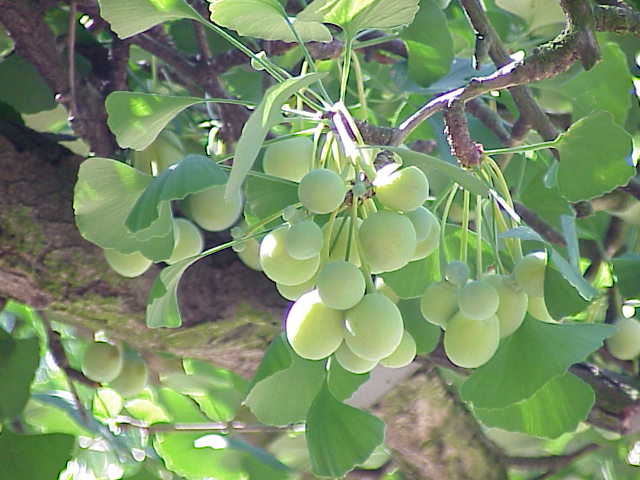
Ginkgo biloba is a neat tree.
Ginkgo is a large tree that will grow to nicely avoid buildings. A lot of trees (like the ash outside my window that I need to remove) love to just grow into whatever. So, from a landscaping standpoint, this unique tree is a good choice to place in a busier location. We have a few on campus, which are well looked after and most people don't pay them much mind. There's also another, though, in a parking lot in downtown Clemson that I didn't know was there until this afternoon.
This tree is essentially bullet proof. It's okay with rain, heat, bugs, you name it. Not much really happens to it, but it doesn't really like road salt or compaction very much. Who does, though? Walk all over your buddies and see how they like it. Same general idea with the root systems of a lot of plants. They need space in that soil to breathe. Generally, though, considering this tree
should be extinct, I think it's faring pretty well.
The yellow leaves are how they look in the fall, which I think is really pretty. Reminds me of bananas as fans.
The veination is neat: it's fanned out as an oddly-palmate type of thing. Each vein is the same width. It's an extremely primitive way of doing things - like liverwort or seaweed. In the scheme of plant development, these came before other, more popular plants, such as angiosperms (flowering ones) and conifers.
Essentially, the plant is outdated, but seems to be doing just fine on campus.
The plant was going to go extinct, but some monks saved it. Asian cuisine loves the nuts, and the leaves are good for helping memory retention - from what I understand. I've also watched a guy eat one, and it didn't seem to be all that tasty, so I think I'll stick with an extract if I feel forgetful.
There are male and female trees, strictly speaking. A lot of plants will have parts from both sexes, but not these guys. The guys (on the left) have the flowers. The females receive pollen much - at least, how I see it - like pine trees. The 'fruits' are technically cones, considering the seed doesn't form in an ovary. Picky picky little details like that mean that the stinky, fleshy pulp around the seed isn't really fruit.
Call it what you will, there's no way I want to open one. It apparently smells like rancid butter. Ew.
Nerd-fact: This is the only land-plant that has sperm that swim with a flagellum. The female has her ovary on the surface, and in wet climates (think ferns) this was an especially convenient way to propagate seed. Generally, though, angiosperms took over (conifers like to just puff out as much of their mess as possible and hope it lands on a girl part somewhere else, which is why I hate them) because, partially, of their great reproductive method. Again, this plant is pretty well out-dated.
I think this photo is GORGEOUS. Look at that fall color! It is a big tree, so I wouldn't put it on a 1/4 acre lot (I'm still unsure why it's in a parking lot downtown; who decided on that? Really?) but if there IS one around it looks brilliant! The course I'm taking is 'Growing Fall Plants', hence the fall-color emphasis I've been using lately.
The plant has good, strong wood, and a decent - not fast - growth rate. It takes horrible soils (just doesn't like a lot of road-salt and people walking on it). It's pretty easy to get along with. It would be hard to say if it's native, considering it's.. well, it's an oddity as far as survival goes. It lives because people wanted it to, pretty much; I doubt it'd be around if the Chinese weren't so appreciative of ginkgo seeds.
This is the bark. I think it's much prettier than the
Acer saccharum was (it was gray-brown and whatnot). The plant, generally, just looks happier and less gloomy than some of the others we've looked at.